
To unleash your natural swing, you have to determine 2 things: your mobile point and your walking style.
The mobile point is essential to turn efficiently and to protect your back. There are two different mobile points, which are incompatible with each other: the top mobile point (D8 vertebra) and the low mobile point (L4-L5 vertebra) Every human being has either a high mobile point or a low mobile point.
The golfer with a low moving point would rotate the upper body and hips as one unit. This profile should never use the offset between the hips and shoulders (the x-factor) to create power. It is the fact of remaining compact that gives it its power.
The high moving point profile is the opposite: the golfer will use the x-factor with great benefit. Players with this profile are able to turn their shoulders a lot while keeping the hips still, which allows them to store a lot of energy, like a spring. To be convinced, just take a look at Rory McIlroy…
A simple exercise to determine your moving point is to sit in a chair with your back straight and to look at a point behind you. The high mobile point profiles can easily turn the head and shoulders without moving the hips (and therefore the legs). Low moving point profiles will not be able to look behind them without having to turn their hips and pivot in their chair.
This simple exercise gives you a first idea of the mobile point. Depending on the flexibility of the person, one can easily conclude that a high moving point (not very flexible) is in fact a low moving point, but this would be a mistake. The profile should be confirmed by another test. On the other hand, a low mobile point can never pass for a high mobile point.
The moving point identified during the first exercise will be confirmed on the practice range. We have said that a high mobile point rotates around the D8 vertebra (at the bottom of the shoulder blades) while a high mobile point rotates around L4-L5 (at the level of the belt) On the practice range, we will stimulate the point mobile either by tapping with the hand or by using a Lacrosse ball against a wall, and then hit one ball. We do this between 5 and 10 times (stimulation -> shot) for the low mobile point, then we do the same with the high mobile point stimulation. We note our sensations: do I experience a feeling of ease more in one case than in the other? More fluidity? Do I feel any discomfort in a case? Etc.
It is possible that the first time you will feel a little confused, especially if you have been playing golf for a long time. This is due to the fact that we have little tendency to let ourselves be guided by our sensations. It will be enough to repeat this exercise on several occasions, but it is important to be fresh and rested to do it. The feeling of freedom from the swing should be very clear.
The moving point never varies! You can lose flexibility or tone, be tired or stressed, but the moving point will remain constant throughout your life.
Now that we know what our mobile point is, let’s move on to the second criterion of the motor profile: the walking style.
Our walking style determines our set-up and our setting in motion, our impulse. Watch people walk down the street. You will see some standing very tall, legs straight, slightly leaning forward. On the other hand, you will see people with very straight and vertical backs, their legs a little bent and who give the impression that the legs are walking in front and the body following. The first walkers are of the Aerial profile and the second of the Earthly profiles.
To better visualize the difference, face a fairly steep slope. If a photo is taken, you will be seen very erect, legs outstretched and weight on the soles of your feet. Watch Tiger Woods in front of his ball, he is in this position.
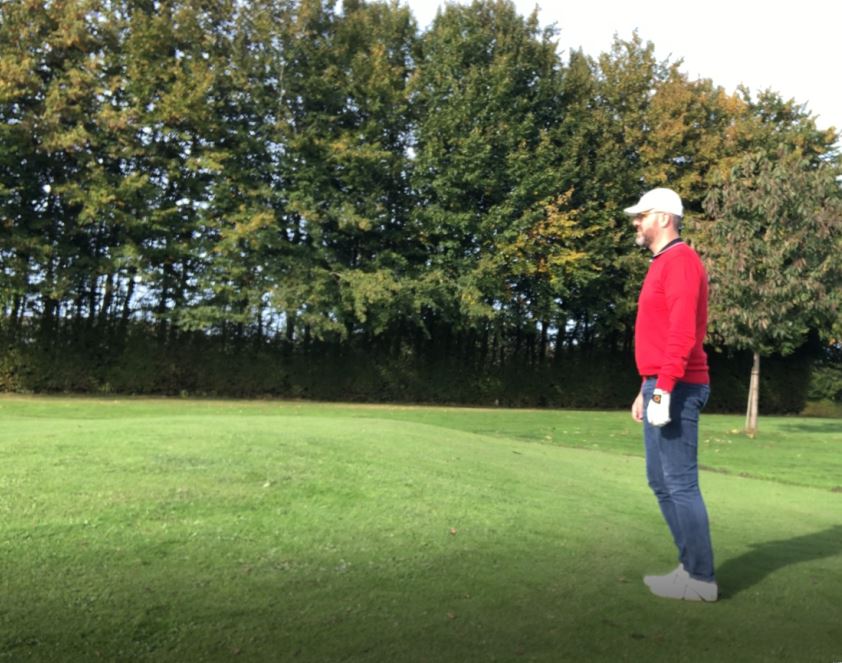
Now stand with your back to the slope. Your back will be very vertical, your legs bent and the weight on your heels. Dustin Johnson is this walker style (of course in front of the ball, he will lean forward to adress the ball)
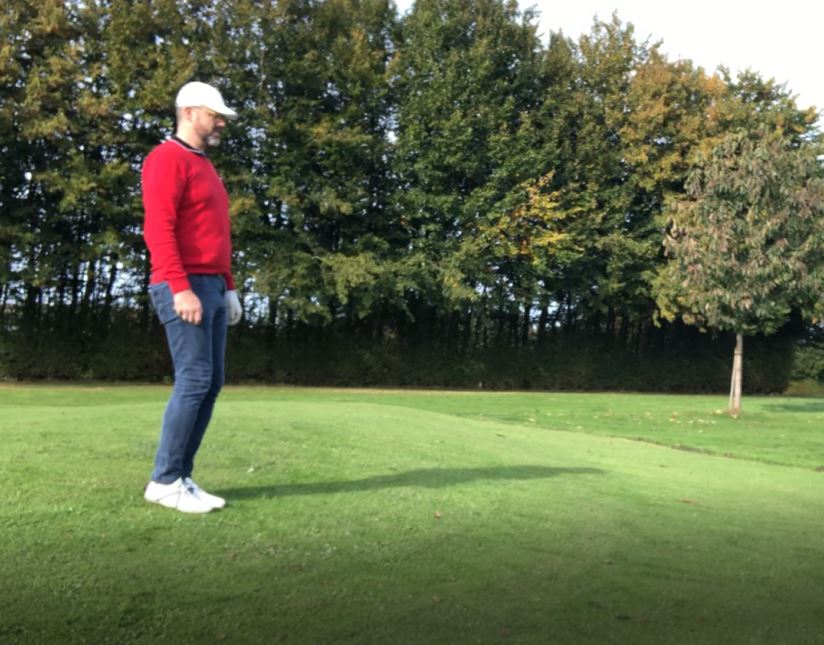
One way to know your walking style is to go from stillness to walking. If you lean forward a bit and then swing your legs, you’re Aerial style. If you “kick” your leg and then lean forward, you’re Earthly style.
On the practice range, to confirm your walking style, you need to be relaxed and rested, as stress and fatigue can confuse the conclusions. As you take your stance, stand on the front third of your feet and swing lightly. Hit 10 balls while getting up before resuming your stance. Then do the same exercise placing your weight on the heels, above the ankles (you should be in balance) If you are much more comfortable in the first case, your walking style is Aerial. If you are comfortable with the weight on the heels, you are Earthly style.
At this point, you should know your moving point and your walking style. Let’s see what this means for you and your swing right away.