
Show me how you walk and I will tell you how to swing
Every year, more than 2 million people start golf in the USA. But every year, as many people stop golf too.
The reasons given are multiple, but there are mainly 4 :
1- Lower back injuries
A study carried out in Europe reveals that back pain or injury is the leading cause of golf stoppage. Another study show that 35% of golfers have already experienced back pain linked to the golf practice. It may seem surprising that people looking for a healthy outdoor activity are forced to abandon it for health reasons!
2- Golf takes too much time
Between individual lessons, group lessons, practice sessions and parties on the golf course, the passion of golf can quickly take up a large part of our free time. If this passion is shared with our family, then it can become a great thing, but it is often an individual passion and that can be a problem. So we have to optimize the time allocated to golf. This brings me to the next point.
3- Golf is too long to master
The time spent to master (a minimum) our swing and our game of golf is important, especially at the beginning. The swing is not a natural mechanical movement: our body is in profile in relation to the target and it is a complex movement to hit a ball placed in different situations. Let’s face it, there are easier movements! There are so many parameters to consider that you sometimes forget the simple pleasure of playing golf and being consistent in your game.
Which golfer is not looking for a trick that will quickly set a random trajectory? Of course, after a one-hour lesson, he will be confident, having plenty of tricks that will work at best for a few days and at worst only a few hours! The golfer will then start chasing new shortcuts without ever understanding why he needs them.
4- Golf is expensive
Yeah, golf is expensive. In the USA, the average price of one-hour individual lesson with a PGA instructor costs between $70 and $125, and it takes a lot of lessons to get a result and to keep it. If you add to that the green fees, the buckets of balls more or less filled, the trips and the equipment, all this is very expensive. And then legitimately comes the question of spending that much hard-earned money in golf.
As for the golf equipment, I do not know a single golfer who has never bought or tried to buy a driver 10 yards longer, or irons that strike straighter or an infallible putter at 3 meters.
Four effects, One cause
In fact, the vast majority of these problems comes from the standardization of the golf swing and by extension of the golfer himself. We try to put the golfer in a box by learning a universal and mechanically efficient classic swing : the academic swing.
I have bad news: this universal and efficient swing does not exist! It is just very practical for the instructor to make us believe it but it does not fit the reality that we are all different!
The first to integrate it are the manufacturers of golf equipment. About 20 years ago, manufacturers promoted their clubs by telling us that they were suitable for the majority of golfers : 70 to 80% of golfers should use their standard clubs. At the time, we had the choice between one steel shaft and one graphite shaft for irons, in senior, regular, stiff, or rarely x-stiff flexibility. For women it was worse: shaft graphite, Ladies flex only! So the standard was the rule. Nowadays, for the same club, we often have more than twenty options grips/shaft/rigidity just as standard. In upgrade, you can even have complementary configurations or even custom-made. Manufacturers have understood that it is up to their equipment to adapt to the golfer and not the other way around!
However, at the same time, the learning of golf swing and golf in general has hardly changed. The swing has become more athletic but remains the same overall, despite the contribution of technologies like the Trackman, high-speed cameras, statistics, etc. We learn to put the ball a little ahead of the stance, to put the weight on the soles of the feet, to transfer the weight, to make a throwing movement with a long and ample finish, etc. Not only is it very complicated, but again it does not suit everyone! Mechanically it’s good, but unfortunately (or fortunately) we’re not robots.
Type of walking
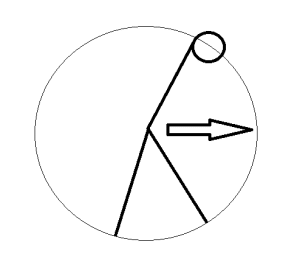
Studies since the 1950s by a Belgian analytical physiotherapist, Raymond Sohier, have shown that there are two types of walking and therefore two types of walkers. We have the “upper walkers” (called Aerial) who trigger their movement by leaning forward and catching up on their imbalance by starting to walk.
On the other hand, we have the “lower walkers” (called Earthly) who start the walk by moving the hips. The legs start first and are caught by the bust to regain the balance. Earthly with a strong profile appear with a straight back when they walk.
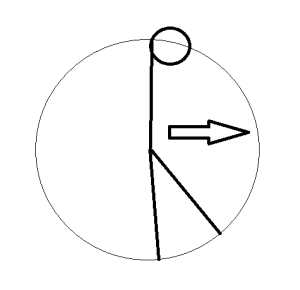
These two types of walking are called moving profiles. In golf, you can recognize an Aerial profile because the golfer is standing very straight in front of his ball (legs almost stretched) and starts his downswing by lowering the head (unbalanced forward). Tiger Woods, Inbee Park, Nelly Korda or Rory McIlroy are perfect examples of Aerial profiles. An Earthly profile will move his head much less at the downswing. However, he will stand lower in front of the ball, more anchored in the ground, with his knees bent and the weight on his heels. Ernie Els, Lydia Ko, Michelle Wie and Dustin Johnson have an Earthly profile. Let us keep these two profiles in mind and go further with another moving characteristic.
The Pivot Point
Other studies have shown that all humans have a natural moving point called a Pivot Point. It is located on the spine, but can be either high (at the level of the shoulder blades), or low (at the level of the belt) We all have a single Pivot Point, either high or low. What’s the point of knowing? Having a High Pivot Point allows the golfer to turn the shoulders a lot in relation to the hips. This is the famous X factor used to gain power. A person with a Low Pivot Point will have little shoulder mobility and will tend to turn the bust as a single block. It is not a problem of flexibility, but of degrees of freedom of the spine: we have some or not! The High Pivot Point profiles are called “Dissociated” while the Low Pivot Point profiles are called “Associated”.

So, what’s the point of golf? Preserve your back!!! A Low Pivot Point profile cannot use the X factor! It’s against its nature. If his instructor pushes him to do it to gain power, the result is guaranteed more or less quickly: back injury! Throwing the hips before the shoulders is impossible for him, and especially counterproductive. This is exactly what happened to me when I started golfing. Having a strong Associated profile, I had a lot of back pain that ended up with a muscle tear and a golf stop for almost a year, while I had followed my instructor’s instructions to the letter and owned a brand-new fitted equipment!
Well, now we come to the following situation:
- There are Aerial and Earthly profiles.
- There are Associated and Dissociated profiles.
It should be noted that these two characteristics (walking and pivot point) are independent of each other. We have 50% of the population with an Aerial profile and 50% with an Earthly profile. We also have 50% of the population with a high moving point and 50% with a low moving point… You see what I’m getting at? Here is the population distribution table, taking into account the walking profile and the pivot point:
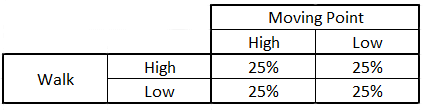
Learning academic golf requires us to stand on the soles of our feet. It’s perfect for an Aerial profile, but ineffective for an Earthly profile (50% of the population). A Dissociated profile is perfect to use the X factor, to strike the ball on the left in the stance, etc. but only represents 50% of the population! In other words, the academic swing, which is very close to the Aerial Dissociated profile, is therefore addressed to only 25% of the population! On the other hand, if you consider not moving your head at the downswing, then the academic swing is no longer addressed to anyone. Careful, I am not saying that a profile is better than another one. A profile is like Nature, not good and not bad. I am not saying also that you cannot move with the academic swing. Millions of golfers do! This is possible, but it requires us to compensate for certain natural predispositions, which will come back in force at the least opportunity. That’s the source of the golf irregularity and the game is much more difficult to master. The search for tips is nothing more than the search for ways to counter our natural tendencies, which always end up coming back. The right question would be, “Can I swing effectively while respecting my natural tendencies?” The answer is a big YES!
In the current state of scientific knowledge, there are 198 different moving profiles. Far from the universal swing, don’t you think?! But don’t panic, we don’t need to take into account so many criteria to unleash our natural golf swing. With 16 profiles only, we already cover the vast majority of game situations encountered. In reality, simply knowing our personal coordination profile is enough to play effectively, with a lot of consistency.
The concept of moving profiles is not new. It was invented/discovered by two volleyball coaches in France in the 1990s, using the studies of Walter Lowen and Jonathan Niednagel mainly. Initially, it was used to promote the learning of techniques adapted and personalized to each player. What they have confirmed over the years is that the 16 moving profiles coincide with the 16 MBTI personality profiles. The personality and learning of movement are formed throughout childhood until the age of 10. Once defined, the moving profile no longer varies over the course of life, unlike the personality that continues to evolve. Why is this method not more widespread if it is really effective? In fact, it is very effective, as evidenced by its results in many sports (volley-ball, handball, soccer, basketball, etc.). On the other hand, there are very few golf teachers trained and until a pro player win a Major by using this method, it will remain under the radar. Publications are becoming more and more common, enthusiastic testimonials more and more numerous, but it will take a big media blow to put it forward. Just remember Dick Fosbury. Before his Olympic title in 1968, won thanks to his famous fosbury-flop, all athletes used forward jumping, without exception. When he ran off, everyone else thought he was crazy. Twenty years later, all the athletes jumped into fosbury-flop…
Fortunately we do not need to win a Major to use the method and become more consistent in golf. Using only a few easy specific tests, it is possible to determine our own moving profile. From this profile, it is easy to do suitable exercises that allow us to unleash and strengthen our natural swing.
I will offer you in the next article some quick tests (to perform alone or with a friend) to define your walking style and your moving point. Then we will do some exercises appropriated to each profile, especially to use the right setup (be careful, it will surprise more than one!)
But first here are some global recommendations:
- Check with your doctor before (re)start physical activity, because even if sport is good for health, a back injury or any other problem can ruin your efforts
- Listen to your body. If you are just starting golf, trust your sensations: pleasant/unpleasant? easy/difficult? Your body knows how to move, so trust it. If you have been playing for a few years, the change can lead to a loss of reference. Allow yourself a little more time before rejecting the method
- Never force yourself!!! If you feel any pain or discomfort, even minimal, stop everything! You’re not using the right moving profile. Everything must be easy and fluid. Resume the tests from the beginning, calmly.
- Don’t worry about other people’s eyes. At golf, you’re alone in front of yourself. No one will hit the ball for you.
- Unless I’ve been lied to, we only have one life, so please yourself!
See you next week to discover your very own moving profile!
Please do not hesitate to leave a comment. And I would be thankful if you could answer to these 2 questions : what are the two main problems you have in golf that stop you to reach your goals? What is your main goal in golf?